In our innovation programs with students, we often began with a deceptively simple exercise: take two things that do not obviously belong together and force a connection.
At first, the combinations sound absurd and students look unsure. But as they start working together ideas start to make sense. An umbrella and a jump-rope becomes a “Jumbrella” — a water-skiing device where you can sit and relax while being towed by a motorboat. The point is not to reward randomness for its own sake but to help students escape the first layer of obvious ideas and enter a more interesting space where new meaning has to be constructed.
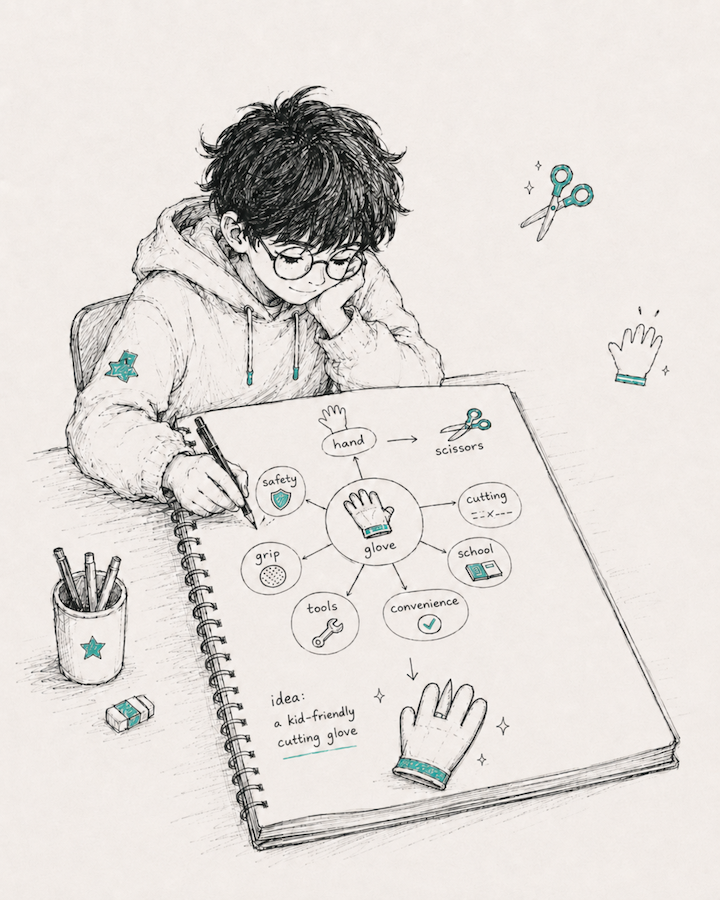
A less random exercise uses association maps where you try to connect ideas that are 2-hops away from the core object that you are trying to improve. One student, using an association map, started with the idea of a glove. And as he drew the map, he reached “scissors” and a new idea emerged: a glove with a cutting blade attached, making it safer and easier for children who find scissors difficult to hold. In the process of bringing the two concepts together, he recognized a common human problem and found a useful solution.
This is what creativity looks like. It is not simply “thinking outside the box.” More often, it is a disciplined way of making novel and meaningful connections.
And the same cognitive techniques that help students invent also help them learn.
Creativity As a Learning Engine
We often treat creativity as a detour from learning, but it is actually one of the most effective ways to learn traditional subjects as well. In another of our programs, students created their own numbering systems as part of an imaginary world-building exercise.
On the surface, this looked like imagination: invent a world, design its rules, create its language, build its symbols. But when students had to create a numbering system, they started doing serious mathematical thinking. A worksheet about place value can tell a student how a base system works. But inventing a base-5 or base-11 numbering system forces the student to confront the mechanics of place value at a deep, structural level.
We usually treat learning and creativity as separate capacities. Learning is associated with acquiring knowledge, mastering facts, and performing correctly. Creativity is associated with novelty, imagination, and original production. But this separation is misleading. At a cognitive level, both require the same fundamental act of viewing the problem from many different perspectives, recognizing gaps in existing mental models and updating them.
A learner encounters something new and must fit it into what they already know. Sometimes the new idea can be assimilated easily. Sometimes it does not fit, and the learner has to reorganize their understanding. A creative thinker does something similar. She takes existing ideas, experiences, concepts, and constraints and recombines them into a structure that did not exist before. In both cases, the mind is not passively receiving information but actively reconfiguring an internal model of the world.
And classroom evidence points in this direction. For example, in one study students learning statistics were asked to invent ways of comparing data sets before receiving direct instruction on standard measures. Their early solutions were often incomplete, but the act of invention prepared them to understand the formal ideas more deeply. Similarly, in science classrooms, students learn abstract concepts more effectively when they create analogies and examine them. A circuit can be compared to water flow, but the analogy must also be questioned. What is like the battery? What is like resistance? Where does the comparison mislead us? Learning does not come from the analogy alone but also from the act of mapping, testing, and revising the analogy. A newer study found that goal-directed association can better explain the creativity-learning link.
Creativity Techniques as Metacognitive Tools
Creative techniques like associative or analogical thinking, are not just ideation tools — they also act as metacognitive tools. Much of our thinking is invisible, even to ourselves. A student might say, “I don’t get it,” without knowing if the roadblock is vocabulary, structure, or a false assumption. However, when that same student maps associations or compares metaphors, their thinking becomes something they can inspect. They can see which connections are obvious, which are missing, which are forced, and which open a new path.
This gives students a toolkit for ambiguity. In school, problems are often presented with clear instructions, known methods, and expected answers. In the real world, the most important problems rarely arrive that way. They are open-ended, poorly structured, and full of incomplete information. The student who has practiced making thinking visible has an advantage. She knows how to begin when the path is unclear: generate associations, map the territory, compare frames, test analogies, revise assumptions.
The AI Challenge
Learning and metacognition are precisely what are at risk with artificial intelligence.
AI can be an extraordinary tool for learning. It can explain concepts, generate examples, translate language, summarize research, and provide feedback at a scale no human could manage alone. But it can also short-circuit the mechanisms through which learning and innovation occur. If students ask AI for the answer before they have formed their own associations, challenged their assumptions and wrestled with their own confusion, they may produce better work but atrophy their thinking skills in the process.
Humans have always used tools to reduce mental effort. We write notes so we do not have to remember everything. We use calculators so we do not have to perform every computation by hand. Offloading is not inherently bad. In fact, civilization depends on it. The question is what and how much we offload.
When we offload storage, we may free the mind for higher-order work. But when we repeatedly offload sense-making, judgment, and creative struggle, we risk weakening the very capacities that make us learn and create.
So, the real question is: How should AI be designed if the goal is not to replace thinking but to stretch it?
An AI tutor could give the answer immediately. Or it could ask the student to first generate three associations, choose the strangest one, and explain how it might connect. A writing assistant could rewrite a paragraph. Or it could offer competing metaphors and ask the student which one best fits the argument and why.
These are not small design choices. They reflect two very different theories of learning. One treats the learner as a consumer of answers. The other treats the learner as a builder of models.
We often associate technology with a certain kind of dopamine loop: the ping, the scroll, the like, the instant answer. This kind of reward captures attention by hacking into our fears and insecurity. But there is another kind of reward that is underused: the reward of insight.
It’s the “aha” moment when a strange association suddenly makes sense. It is the pride and satisfaction of finding a clever solution to a real problem. That is the “better dopamine” to use. We should design systems that provoke association, analogy, reflection, and metacognition. That can lead to a more effective and beneficial partnership between humans and AI.