By the late 1960s, the automobile assembly line stood as one of modern management’s great achievements. It had transformed carmaking into a system of extraordinary scale, speed, and consistency. Yet the same system was experienced very differently by many of the people working within it. Describing his job in a General Motors paint shop, one worker quipped:
“There’s a lot of variety in the paint shop. . . . You clip on the color hose, bleed out the old color, and squirt. Clip, bleed, squirt, think; clip, bleed, squirt, yawn; clip, bleed, squirt, scratch your nose. Only now the Gee-Mads [the General Motors Assembly Division industrial engineers] have taken away the time to scratch your nose”.
The worker remained essential to production but had little authority over the work as a whole. He was, quite literally, a human in the loop.
Several thousand miles away, another worker also repeated a small set of movements every day. Behind his ten-seat sushi counter in Tokyo, Jiro Ono sliced fish, shaped rice, pressed, and served with gestures refined over decades. From a distance, his practice could appear almost as standardized as the automotive work. Yet its apparent sameness concealed continual variation. Rice changed with temperature and humidity; different fish required different preparation; pressure appropriate for one piece could be excessive for another. What looked to a novice like execution of a recipe was, for the master, a sequence of situated judgments developed through attentive practice. Ono described his process simply:
“I do the same thing over and over, improving bit by bit. There is always a yearning to achieve more. I’ll continue to climb, trying to reach the top, but no one knows where the top is. Even at my age, after decades of work, I do not think I have achieved perfection. But I feel ecstatic all day.”
Ono’s repetition made his perception increasingly discriminating. Each iteration provided feedback, improving both the outcome in the present and his ability to judge more finely in the future.
The automobile worker and the sushi master therefore present a paradox. Both repeat, operate within constraints, and participate in larger production systems. Yet repetition degrades the work of one while making it meaningful to the other. The difference is not repetition itself, but how work distributes agency, cognitive challenge, and opportunities for learning.
The contrast raises an important question for the age of generative AI:
Will AI make more of us like Jiro Ono or more like the assembly-line worker?
The answer may have less to do with the sophistication of the technology than with how we choose to design work around it.
A new kind of Fordism
Much of the conversation about AI and work focuses on jobs: Which jobs will disappear? Which professions are safe? What percentage of a role can be automated?
Those are reasonable questions, but long before AI eliminates an occupation, it can redistribute the thinking used in that occupation.
Imagine a teacher who once designed lessons himself but now increasingly asks AI to create them and then reviews the result. Their productivity might have increased but something important changed in the process. As AI performs more of the judgment-rich activities through which the person previously learned, experimented and developed expertise, human work becomes narrower, limited to prompting, checking, approving and correcting.
We call this emerging pattern cognitive Fordism: a division of cognitive labor in which AI increasingly performs the thinking through which people develop judgment, while humans are left supervising AI’s output.
This raises a fundamental question: Which parts of our thinking are we happy to outsource, and which parts do we need to keep exercising if we want people to remain capable?
Not every use of AI should look the same
One reason this question is difficult is that the same task can mean very different things to different people.Suppose three people ask an AI system to help write a report.
The first person understands the subject thoroughly so writing the report might simply be a routine task for them. Having AI produce a draft may be an excellent use of automation for such a person.
The second person is new to the field. Writing the report is partly how they will learn to structure an argument and understand the material. Generating the answer for them may save time today while removing the very struggle that would have developed their capability tomorrow.
The third person is trying to invent a completely new approach. They may not want AI to give them an answer at all. They may want it to challenge assumptions, offer unusual alternatives and provoke new directions.
So while on the surface, the activity might look the same it needs three completely different interaction models with AI.
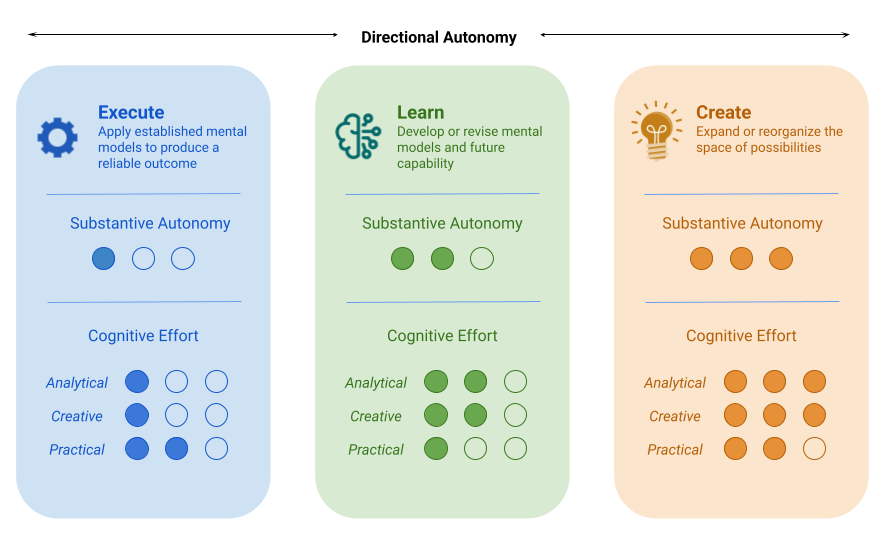
This is why the conceptual framework in the figure above begins not with the task itself, but with the person’s intention. It describes three broad orientations for AI-mediated work: Execute, Learn and Create.
In Execute, the goal is reliable completion. We already know roughly what good looks like, so allowing AI to carry more of the workload makes sense.
In Learn, the goal changes. The immediate answer matters less than what the person will understand or be able to do afterwards. Here, the best AI may behave more like a tutor by offering explanations, questions or graduated hints rather than simply completing the task.
And in Create, the objective is neither efficient execution nor mastery of an existing solution. It is expanding the possibility space. AI becomes a thought partner: generating alternatives, challenging assumptions or helping connect ideas that might otherwise remain separate.
These orientations are not a ladder in which Create is somehow superior to Learn and Learn superior to Execute. Sometimes execution is exactly what we want. There is little benefit in forcing a senior scientist to manually perform routine writing if their attention would be better spent solving a difficult scientific problem.
The mistake is using Execute as the default relationship for everything simply because AI can produce an answer quickly.
Agency plays a strong role
Most moderately complex work does not stay neatly inside Execute, Learn, or Create. People continually move between them.
A scientist may first need to learn enough to understand an unexpected result, then create several possible explanations, then execute an experiment to test them. The outcome may trigger another round of learning, reframing, and experimentation. The same is true in many professional and educational tasks.
That is why agency matters so much in AI-mediated work.
If the appropriate relationship with AI changes as the work unfolds, people need the ability to change that relationship too. We call this directional autonomy: the ability to influence whether the interaction is oriented toward Execute, Learn, or Create. This is different from substantive autonomy, which concerns how much authority a person has over the work itself—its goals, framing, methods, and standards.
Both matter, but they are not equally available in every situation.
An employee may have little control over the objective they have been assigned. A student may not get to choose the learning outcome, assessment criteria, or even the method they are expected to use. In those situations, substantive autonomy is partly constrained by the surrounding organization, teacher, or institution.
But even when people cannot choose what they are ultimately trying to accomplish, they can still benefit from having some control over how cognition is divided between themselves and AI.
This is why an AI system should not lock someone into a single mode simply because it inferred that mode at the beginning of a task. The system might reasonably infer that the user is trying to Execute, Learn, or Create, but that choice should remain visible and easy to override.
Without that flexibility, AI risks pushing people toward a default role (often execution and supervision) even when the work actually calls for learning or creative exploration.
From AI adoption to work design
Organizations can easily fall into a productivity trap when using AI. It’s easy to see how much coding was completed or how quickly an email was written. But human development is harder to see. Did the student deepen their understanding of the topic? Or, did a manager develop better judgment? These capabilities accumulate slowly, often through exactly the parts of work that initially feel inefficient: wrestling with uncertainty, considering alternatives, making mistakes and revising our thinking.
Prioritizing short-term efficiency over deep engagement can erode the very skills needed for future work, putting sustained success at risk.
Viewed from a long-term perspective, incorporating AI becomes a work-design problem, not just a technology-deployment problem. At an organizational level, that might mean conducting a cognitive audit: examining where AI is taking over analytical, creative and practical effort; whether employees can reclaim or redirect that work; and whether jobs are becoming richer or slowly collapsing into narrow monitoring and approval activities.
The future of human–AI collaboration should be judged by more than the speed or quality of the output. A good system should help us produce better work without reducing our capacity to shape the work that comes next.