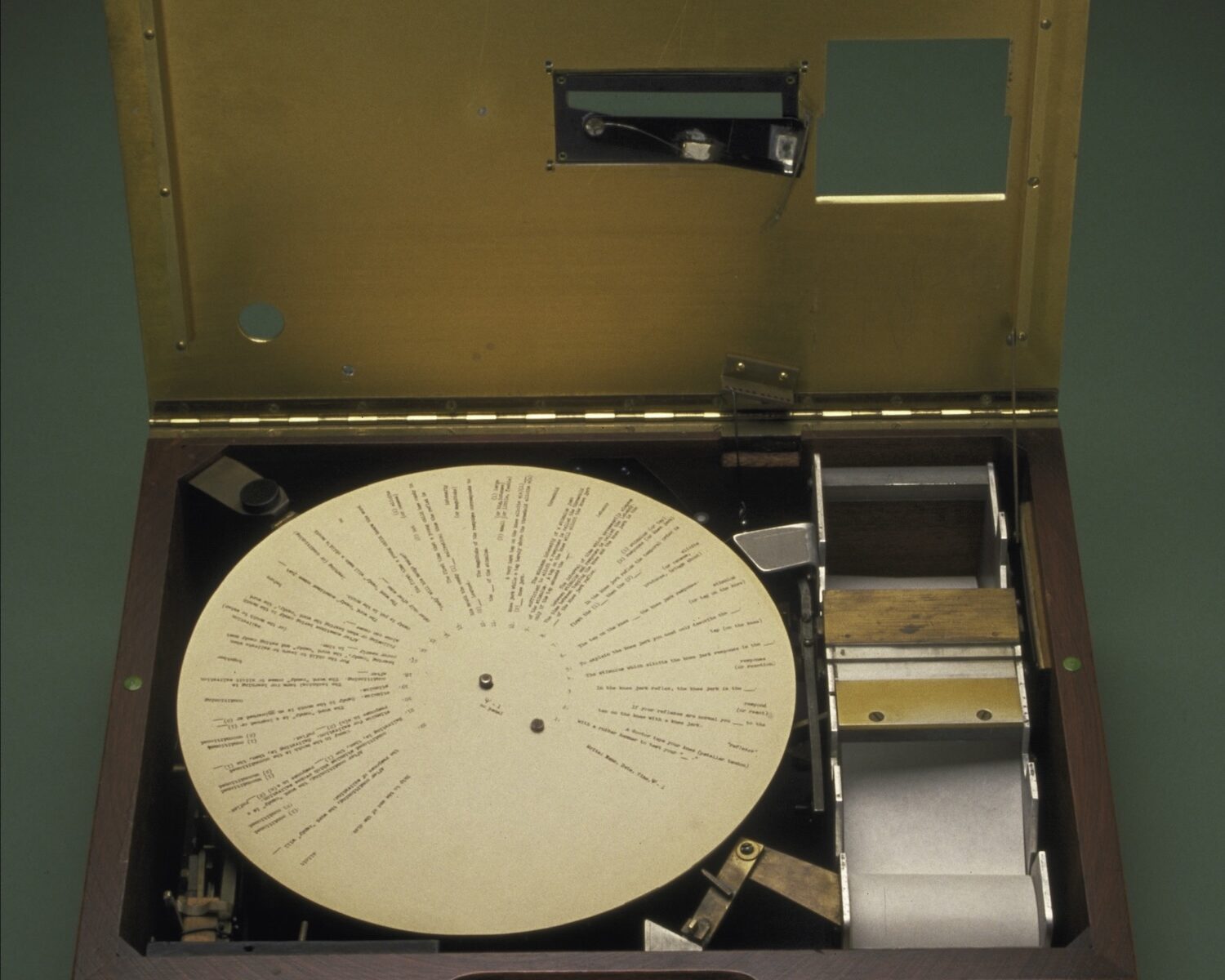
When Harvard psychologist B. F. Skinner visited his daughter’s fourth-grade mathematics classroom in 1953, he was troubled by what he saw. Some children completed their arithmetic exercises quickly and waited impatiently. But others struggled to keep up while the teacher moved between desks, trying to help everyone.
Skinner saw an opportunity. What if a machine could give every child immediate feedback and let students progress at their own pace?
Within days, he built a prototype of what became known as the teaching machine.
But Skinner wasn’t the first to pursue this idea. Nearly three decades earlier, Ohio State University psychologist Sidney Pressey had developed mechanical devices for individualized instruction.
When Skinner’s inventions began attracting national attention, Pressey wrote to him with a warning about his own experiments:
“In successive runs through the machine, students did indeed learn very rapidly, and so far everything looked encouraging. But then, and also in more recent experimentation, when I checked on that learning by repeating some of the material verbatim but in a little different context a week later, very little appeared left.“
Pressey had discovered something important: Students could perform remarkably well while using a teaching machine without developing lasting knowledge.
Seventy years later, researchers at the University of Pennsylvania reported an eerily familiar result. In a 2025 randomized study involving nearly 1,000 high-school mathematics students, access to a GPT-4-based assistant improved practice performance by 48%. But when students subsequently took an examination without AI assistance, they scored 17% worse than students who had never used the tool. A more carefully designed AI tutor, which guided students rather than providing answers, avoided this decline but didn’t produce any detectable improvement on the unassisted examination.
Why has the alluring promise of personalized learning so often failed to deliver better educational outcomes? Three fundamental challenges might be behind this.
The Unpredictability Problem
Imagine a ten-year-old fascinated by dolphins.
A personalized learning platform detects this interest and begins incorporating dolphins into reading passages, science lessons, and mathematics exercises. The child responds enthusiastically, reinforcing the algorithm’s confidence.
Then, one afternoon, the child’s best friend declares that sharks are much cooler. Overnight, seeing a dolphin problem in their coursework becomes irritating.
This hypothetical scenario captures something fundamental about human learning.
Our interests are not fixed characteristics that an algorithm can always predict from past data. They evolve through experiences, relationships, and unexpected encounters as research on interest development shows.
In addition, unpredictability extends beyond student interests to the structure of knowledge itself. For effective algorithmic personalization we need accurate maps showing how knowledge develops, assessments that pinpoint where each student stands, and instructional materials appropriate for every next step.
While these elements are easier to manage in structured fields like math, they get much trickier when students are learning to interpret literature, build historical arguments, evaluate competing scientific theories, or practice ethical judgment. In these areas, there’s rarely a single predictable path to understanding.
Great teachers do more than discover what students already enjoy or understand. They introduce unfamiliar ideas, challenge existing assumptions, and awaken interests students never knew they possessed.
The Isolation Problem
In 2008, a meta-analysis of 148 studies covering over 17,000 teenagers showed that students learning cooperatively demonstrated higher achievement and developed more positive peer relationships than students working in competitive or individualistic learning environments.
Learning is not simply absorbing information in isolation. As social animals, we actively construct understanding through our interactions with others.
A compelling illustration comes from a longitudinal study of ~700 students across three California high schools. At Railside School, students of different abilities tackled challenging mathematics problems together. Rather than progressing independently through predetermined sequences, they discussed strategies, challenged explanations, and built understanding collaboratively.
As a result of the intervention, 41% of seniors enrolled in advanced mathematics classes, compared with 27% at the comparison schools, and many of the initial demographic achievement gaps disappeared.
More importantly, peer learning also cultivates metacognition: the ability to understand, monitor, and regulate one’s own learning.
Students discover how classmates approach unfamiliar problems, recognize confusion, manage frustration, organize their efforts, and seek help. A student who struggles silently might learn from watching a peer ask a thoughtful question. Another might discover that a classmate solves difficult problems by breaking them into smaller steps.
Over-personalization risks isolating students. When every learner follows a separate instructional path, these critical metacognitive skills are much harder to build. Personalization doesn’t have to eliminate collaboration, and technology can certainly support shared learning, but that is rarely the primary focus.
The danger arises when individual optimization becomes education’s organizing principle while shared experiences take a back seat. Paradoxically, in attempting to cater to individual needs, we risk stripping away one of learning’s strongest mechanisms: exposure to other people’s differences.
The Motivation Problem
In a fascinating series of experiments, researchers investigated how students respond to critical feedback from teachers.
When 7th-grade students received critical feedback paired with a note emphasizing their teacher’s high standards and belief in their potential (also called wise feedback) they were far more likely to revise their essays and turn in higher-quality final work. Among Black students, the proportion choosing to revise their essays increased from 27% to 64%.
The message worked not through praise or reduced expectations, but through a powerful combination of trust, care, and challenge. Broader research reinforces the importance of these relationships. A meta-analysis of 99 studies found that positive teacher-student relationships were associated with greater student engagement and moderately stronger academic achievement.
Replicating this relational impact on a learning platform is challenging. A tool can adjust difficulty, offer instant feedback, and generate encouragement. But supportive language from a chatbot rarely carries the same weight as encouragement from a trusted mentor.
This gap helps explain why sophisticated personalized systems often fall short. Students excel when someone they trust inspires them to reach further.
What the Failures of EdTech Personalization Should Teach Us About AI
Artificial intelligence is again reviving the educational ambitions that inspired Pressey and Skinner.
The current technology is unquestionably more sophisticated. AI can conduct conversations, explain concepts in multiple ways, identify misconceptions, and deliver individualized feedback at an unprecedented scale.
These capabilities create genuine opportunities. But they do not eliminate the fundamental challenges of unpredictability, social learning, and human motivation.
There is also a fourth lesson, implicit in Pressey’s century-old warning. Learning requires cognitive effort and some of that effort cannot simply be engineered away. Research on the science of learning consistently demonstrates the importance of retrieval practice, spaced repetition, and opportunities to revisit knowledge over time.
Technology can make these processes more efficient. AI can diagnose misconceptions, schedule appropriately spaced practice, generate productive questions, and provide feedback precisely when it is needed. But there is a difference between removing unnecessary friction from learning and removing the cognitive work that makes learning possible.
So instead of asking whether AI helps students zip through assignments or get higher scores in the moment, we need to ask better questions. Are they actually retaining what they learn? Can they apply that knowledge to brand-new problems without a digital safety net? Are they developing the confidence to struggle through hard tasks on their own? And just as importantly, is AI helping strengthen the human connections and team experiences where true learning takes place?
Perhaps the greatest opportunity for AI is not to build a perfectly individualized educational experience for every student, but to help teachers create richer, more challenging, and more human learning environments.
Image credit: Smithsonian National Museum of American History